
The Mythmaker and the Past
Excerpt from the Londinium canon — a glimpse into myth, memory, and inheritance

This excerpt is drawn from the first draft of The Londinium Tales, and is set in the Great Room of the Royal Society of Arts—a historic venue just off the Strand, known for its Enlightenment lineage and lectures that walk the line between scholarship and spectacle.
Dr. Sebastian Hugh Campbell, a Cambridge scholar and renowned popular philosophy author, addresses the mythology of the Ripper to a Metro audience. Watching from the edge is Theo Morgan-Ashbourne, a product of the Londinium aristocratic legacy.
The scene marks Campbell’s first present-day appearance in the narrative, and offers a glimpse into Londinium’s academic undercurrents—and the quiet history between these two characters.
The Great Room, Royal Society of Arts
The air inside the Great Room was taut with expectation, its vaulted ceilings lending an almost ecclesiastical weight to the occasion. A modern projector hummed softly, casting sharp white light against a grand screen. The audience—a mix of academics, journalists, and curious intellectuals—filled every row, their faces illuminated by the ambient glow of polished chandeliers.
Sebastian Hugh Campbell stood at the podium, his presence commanding yet unassuming. He didn’t need to demand attention; it followed him naturally. His dark grey suit was impeccably tailored, his tie a subtle pattern hinting at sophistication rather than ostentation. A thin pair of glasses rested on the bridge of his nose, giving him the air of a man who belonged to both past and future.
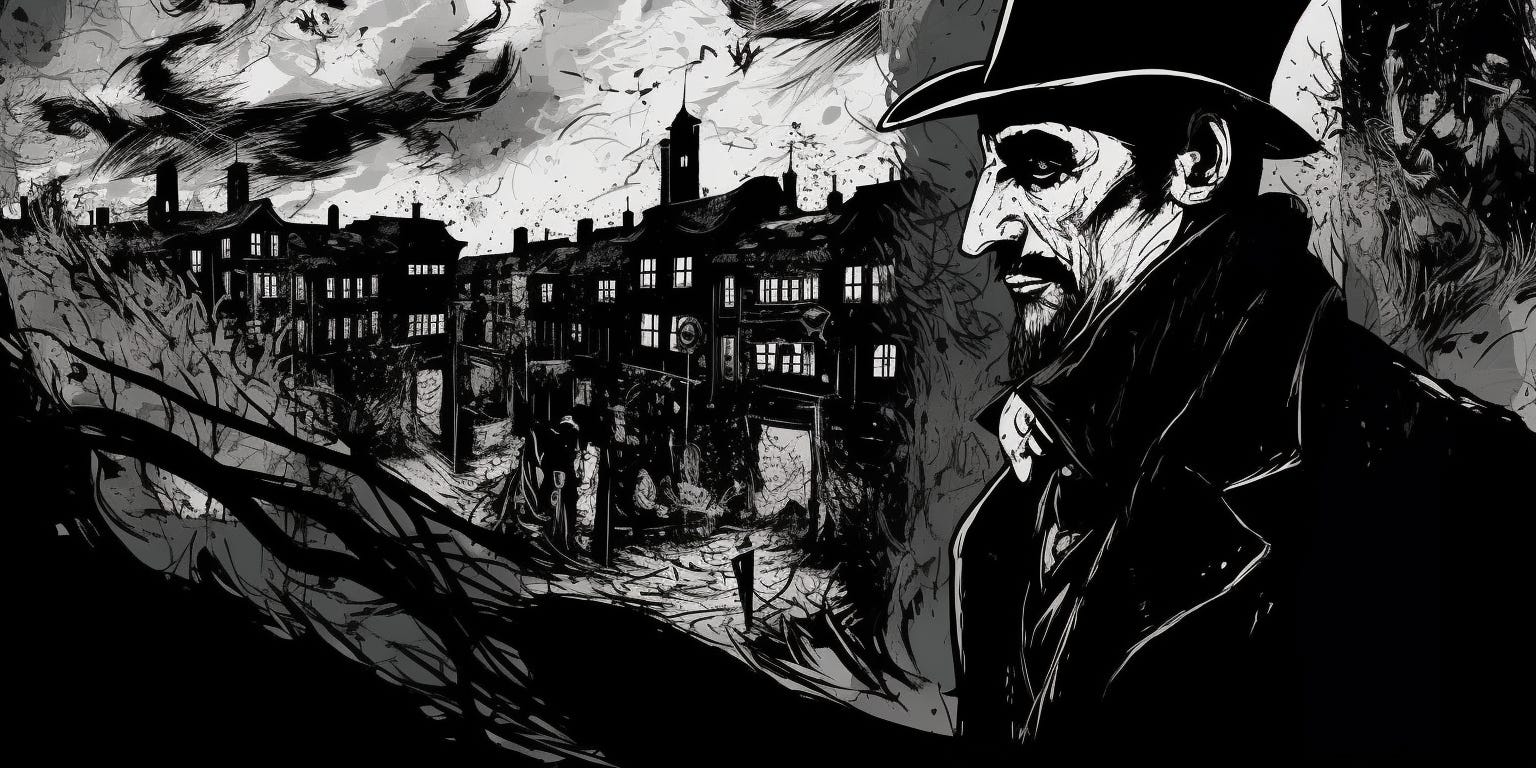
“The Ripper,” Campbell began, his baritone measured yet conversational, “is a cipher. A figure so bound to London’s collective psyche that his name carries weight far beyond his deeds. He is not merely a murderer. He is an answer to a question we didn’t know we were asking.”
The room was silent. He let it linger, scanning his audience with the faintest hint of a smile, as though daring them to challenge him.
“You see, the Ripper emerges not from crime but from myth. When an era ends, as it did during the upheavals of the Victorian age, the city’s soul must reckon with its transformation. And in its reckoning, a figure is born—someone to embody its anxieties, its fears, its anger at what is lost and what cannot be reclaimed.”
Campbell turned to a new slide on the screen, an old map of Whitechapel overlaid with glowing ley lines.
“The Ripper, I propose, was not merely a man. He was a myth in the making. And myths,” he added with a slight tilt of his head, “do not fade as easily as facts.”
The applause began scattered but soon swelled, rippling across the room like a tide. Campbell inclined his head graciously, his expression betraying nothing beyond a faint satisfaction.
As the room settled, chairs scraped against the polished floor, and a low hum of conversation filled the space. The crowd began to disperse, funneling towards the book-signing table in a steady stream.
Theo Morgan-Ashbourne lingered near the edge of the gathering, his sharp amber eyes scanning the room. He had not been among the applauders. Not because the speech wasn’t brilliant—it was, as expected—but because applause felt redundant. Campbell already knew the power of his own words.
When the crowd began to thin, Theo approached the signing table. Campbell’s dark eyes met his with a flicker of recognition, and a small smile played at his lips.
“Theodore,” Campbell said smoothly. “I didn’t expect you here.”
Theo returned the smile, the corners of his mouth lifting just enough. “Sebastian. I wouldn’t miss it.”
Campbell gestured to the book in Theo’s hand—a freshly printed volume with a minimalist cover, featuring elegant, stylised typography that bore all the hallmarks of a “Classic” series from a major publisher. “And? Did it pass your impossible standards?”
Theo raised an eyebrow, a hint of wry amusement playing on his lips. “It is as riveting as ever—bold, incisive, and teetering on the precipice of academic heresy. A quintessentially Sebastian Hugh Campbell work, reminiscent of the provocations I recall from my student days. Though, perhaps the more pertinent question is this: have I in my hands the unvarnished truth, or merely the Metro-approved, sanitised rendition?”
Campbell’s laugh was quiet, almost indulgent. “Ah, you’ve caught me. Naturally, it’s sanitised—a publisher prefers its ‘pop-philosophy’ neatly packaged and marketable. But you and I both understand that the real story is far more unruly and inconvenient.”
“Far less tidy,” Theo agreed, a subtle smile tugging at the corners of his mouth. “But still, quite the performance.”
Campbell set his pen down and straightened, his gaze sharp. “And you? Still dabbling in Londinium’s politics, I hear.”
Theo’s smile tightened, his tone measured. “Something like that.”
“Come,” Campbell said, rising and gesturing for Theo to follow. “Let’s catch up properly. I have just the place in mind.”
The Savoy, The Gallery
Campbell led the way, weaving through the city’s streets with the ease of someone who had long mastered its rhythms. Theo followed, the crisp afternoon air brushing against him, tinged with the faint, briny scent of the Thames.
Soon, they arrived at the Savoy, its timeless elegance welcoming them as they stepped inside. The soft glow of chandeliers and the quiet clink of silverware enveloped them in an atmosphere of refined luxury.
The Gallery, with its polished silver teapots and hushed conversations, was a perfect choice. They settled at a small table by the window, the glittering Thames stretching beyond the glass like a ribbon of light. Between them, a half-empty pot of Earl Grey rested, its steam curling lazily into the air.
“Cambridge is much the same,” Campbell said, his tone lightly nostalgic. “The humanistic academics remain blissfully ensconced in their own world. That hasn’t changed since I first lectured at Oxford—what was it? The Sheldonian?”
Theo chuckled, swirling his glass of scotch with deliberate ease. “Ah, yes. The guest lecture that had half the university packed into the hall. ‘Myth and the Human Psyche,’ wasn’t it? Every seat taken, students crammed in the aisles... It was the sort of event that made Oxford feel alive.”
Campbell gave a small smile, his gaze sharpening slightly. “And you were the Balliol freshman who stood up during the Q&A and asked about the narrative parallels between mythic transformation and modern psychological frameworks. I remember thinking, ‘Either this boy is insufferably precocious or genuinely insightful.’”
Theo tilted his head, the faintest smirk playing at his lips. “And which was it?”
“Oh, insightful, certainly,” Campbell replied, leaning back in his chair. “Precociousness is a given at Oxford. What stood out was your genuine curiosity—tracking me down after the lecture to press further on my points about symbolic resonance. Most students ask questions to be heard; you asked because you wanted to know.”
Theo’s smirk softened into something more thoughtful. “It was rare to hear someone talk about myth in a way that felt... alive. Like it wasn’t just some relic of the past but something still breathing, still relevant. It stayed with me.”
Campbell nodded, his tone warm but laced with subtle intrigue. “That’s why I kept in touch. Most students, you see, absorb what they’re given, regurgitate it when required, and then move on, leaving little trace of the exchange. Necessary, I suppose, for the machinery to keep turning, but uninspiring all the same. Then, once in a rare while, someone comes along who actually listens—who questions, pushes, and forces you to see the work in sharper relief. It’s not common, Theo, but it’s memorable when it happens. And you—well, you’ve always had a way of cutting to the marrow of things, haven’t you?”
Theo raised his glass slightly in a gesture of acknowledgment. “And you’ve always had a knack for reminding me why I ask the questions I do. It’s been quite the dynamic, hasn’t it?”
Campbell chuckled softly. “Indeed. Though I wonder how much of that student I met at Balliol still lingers beneath all this...” His hand made a subtle, sweeping motion to encompass Theo’s current polished yet enigmatic demeanor. “I’ll admit, I was disappointed you didn’t pursue the academic path. You could have done extraordinary work in the field.”
Theo’s smile tightened, the sharp edges of his mask slipping neatly into place. “Politics seemed more… immediate.”
“Immediate,” Campbell echoed, his gaze sharpening ever so slightly. “Pragmatic, indeed. Though, if memory serves, there were aspects of your path that seemed... inevitable, shall we say? Or perhaps that was merely the impression I gathered from our earlier conversations. In any case, I wouldn’t presume to pry into your motivations—you’ve always had your reasons.”
Theo’s lips curved into a faint, wry smile as he swirled his glass. “Inevitable is a fitting word, though it has a certain fatalistic charm I’d rather not indulge. Let’s just say the Morgan-Ashbourne legacy is less of a path and more of a... gravitational pull. You can rebel against it all you like, but eventually, you find yourself back in orbit. I’ve learned to stop fighting the inevitable—well, for now.”
“Perhaps it’s not too late,” Campbell said, his tone carrying a hint of dry amusement. “If the endless Londinium games ever lose their charm, my door is always open. You’d make a brilliant student.”
“I’ll keep that in mind,” Theo replied, a glint of humour in his eyes. “Though, for the record, I have no intention of returning to essay deadlines or grading schemes.”
Campbell raised his glass, his smile faintly sardonic. “A pity. I suspect you’d have more to teach me now than the reverse.”
Their smiles held, layered and opaque, each man acknowledging the unspoken. To an outsider, it would seem no more than a cordial reunion of old acquaintances exchanging pleasantries. But Theo couldn’t ignore the subtle undercurrent in Campbell’s tone—an unspoken invitation, a faint challenge, or perhaps a warning.
The conversation meandered onward, touching on inconsequential topics, yet the weight of their shared history—and the shadows of their present—remained, unspoken but unmistakable.
—
About The Londinium Tales
A contemporary fantasy set beneath the surface of modern London, The Londinium Tales follows a team of demon hunters navigating layered magic, concealed histories, and the weight of legacy.
At its core is a fractured city where myth never quite died—only faded. Some fight to protect what remains. Others arrive to rewrite it.